Education & Learning Development
1: EXECUTIVE SUMMARY
This Education Sector Assessment presents a comprehensive analysis of the current
education landscape in Jubaland State, Somalia, conducted by Tayo Resilience
Foundation (TRF), the assessment evaluates access, quality, infrastructure, gender equity,
and institutional capacity within the education system, the findings reveal significant
disparities between urban and rural areas, persistent teacher shortages, and limited
learning resources, However, strong community demand and existing institutional
frameworks offer opportunities for impactful and resilient education interventions.
2: BACKGROUND AND CONTEXT
Jubaland State has a young and rapidly growing population, making education a critical
pillar for long-term stability and development, Years of conflict, displacement, and
underinvestment have weakened education service delivery, particularly in rural and
hard-to-reach areas. Both formal and non-formal education systems operate in Jubaland,
supported by government, NGOs, and community-based initiatives.
3: OBJECTIVES OF THE ASSESSMENT
- Assess access to education services across Jubaland regions
- Evaluate the quality of teaching and learning environments
- Identify infrastructure and human resource gaps
- Analyze gender equality and inclusion
- Provide evidence-based recommendations for NGOs and partners
4: METHODOLOGY
The assessment employed a mixed-methods approach, including desk reviews of existing
education reports, key informant interviews with education officials and school
administrators, community consultations, and observational visits to selected schools
across Jubaland.
5: REGIONAL OVERVIEW OF EDUCATION
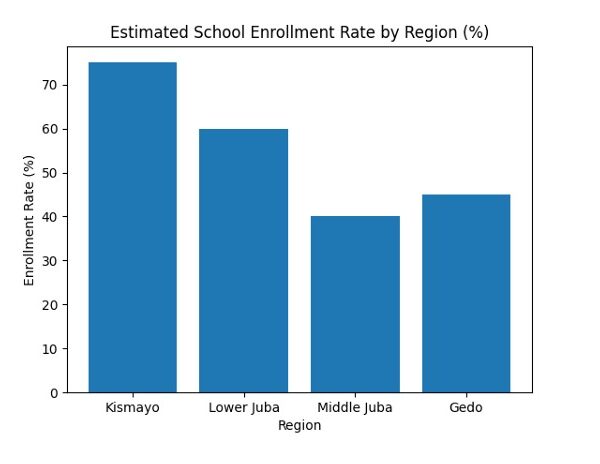
- Kismayo: Higher school enrollment and relatively better infrastructure
- Lower Juba: Moderate access with overcrowded classrooms
- Middle Juba: Severely limited access due to insecurity and displacement
- Gedo: Acute shortages of schools, teachers, and learning materials
6: ACCESS TO EDUCATION (EVIDENCE)
Enrollment rates vary significantly across Jubaland, with urban centers showing higher
participation than rural and conflict-affected areas.
7: GENDER AND INCLUSION ANALYSIS
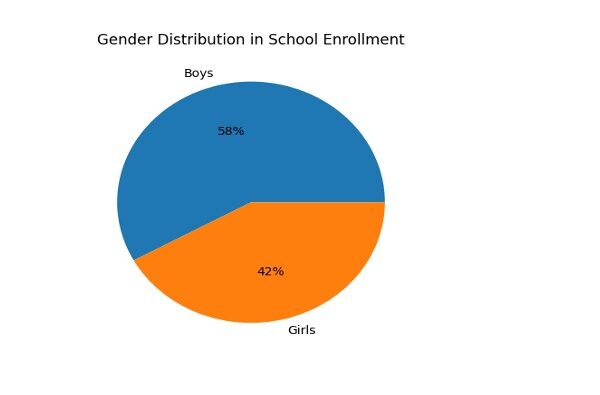
Gender disparities persist across all regions, with girls facing barriers including early
marriage, household responsibilities, and limited availability of female teachers.
8: KEY CHALLENGES IDENTIFIED
- Inadequate school infrastructure
- Shortage of trained and motivated teachers
- Limited teaching and learning materials
- Gender inequality in enrollment and retention
- Weak education governance and coordination
9: OPPORTUNITIES AND STRENGTHS
- Strong community demand for education services
- Presence of education partners and NGOs
- Existing Ministry of Education structures in Jubaland
- Potential for resilience-focused education programming
10: RECOMMENDATIONS
- Invest in school construction and rehabilitation
- Support teacher training, certification, and incentives
- Promote girls’ education through community engagement
- Strengthen coordination with the Jubaland Ministry of Education
- Integrate education with resilience and emergency response programs
11: CONCLUSION
Improving education outcomes in Jubaland requires sustained, coordinated, and
inclusive interventions. Tayo Resilience Foundation is well-positioned to support
evidence-based education programs that enhance access, quality, and resilience for
children and youth across the region.